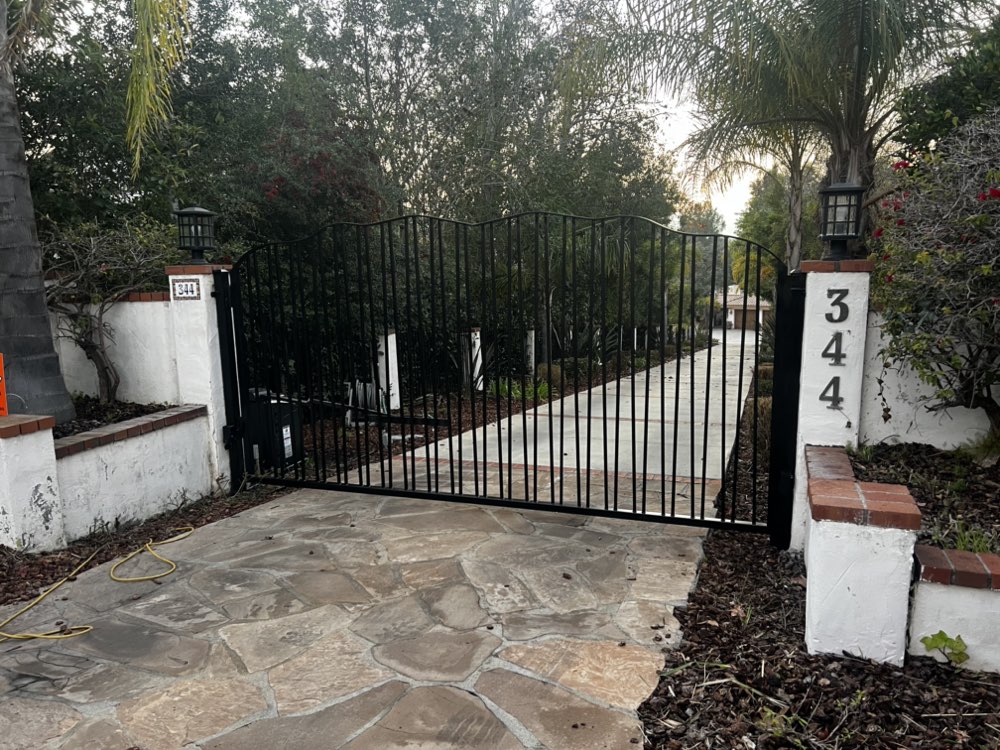
A driveway gate is one of the few things on a property that is both structural and mechanical. That means it can fail in two quite different ways, and the right answer depends on which one you are looking at.
The useful distinction: mechanical problems are almost always worth repairing. Structural problems depend on how the gate was built in the first place.
Almost Always Worth Repairing
The opener has died
Gate operators fail in predictable ways — capacitors, control boards, limit switches, worn gears. Many of these are modest parts. Even a full operator replacement is usually far less than a new gate, and the gate itself is untouched.
One caution: if your operator is very old, parts availability becomes the deciding factor. There is a point where a repairable fault is not economically repairable because the board has not been made in a decade.
The gate sags, drags or will not latch
This looks like a gate problem and is usually a hinge or post problem. Iron gates are heavy and hang off two points; hinges wear, and posts shift if the footing was undersized or the soil moved. Re-hanging a gate, replacing hinges, or resetting a post is straightforward work that often makes a twenty-year-old gate close properly again.
Rollers, track or hardware on a sliding gate
Worn rollers and damaged track are wear items on a rolling gate. Replacing them is routine. If your track constantly clogs with leaves and grit, that is also the moment to ask whether converting to a cantilever design makes sense.
Surface rust
Rust on the surface of a well-built gate is cosmetic and fixable — strip, treat, refinish. Around the coast this is normal maintenance, not failure.
You want better access control
Adding a keypad, smartphone control or intercom to a working gate is one of the best-value upgrades available, because you keep the gate and the motor and add only the access layer.
Where Replacement Usually Wins
Rust has gone structural
There is a real difference between rust on the metal and rust through it. Once sections have lost material — particularly at the bottom rail, where water sits — you are patching something that will keep failing next to the patch. A good test: press firmly at the lowest points. If it gives or flakes through, the gate is telling you something.
The gate was built too light for the opening
Some gates are undersized from day one — thin stock over too wide a span. They sag no matter how many times they are re-hung, because the frame itself is deflecting. Repairing this is repeatedly paying to fix the same design decision.
Repeated repairs in a short window
If you have paid for three fixes in two years, you are on a payment plan for a gate you do not own yet. Add the receipts up before authorizing the fourth.
You want it to look different
A perfectly sound gate you dislike is not a repair question. Worth knowing that refinishing, or adding ornamental detail to a plain but structurally good gate, sits between repair and replacement and costs a lot less than starting over.
A Rough Rule
If the frame is sound and square, repair. If the frame has lost material or was never adequate, replace. Hardware, motors and finishes are all replaceable around a good frame — the frame is the part you cannot economically fix.
What We Do on a Repair Call
We look at the gate, the posts, the hardware and the operator, and we tell you which of the two situations above you are in. If it is worth fixing, we quote the fix. If it is not, we will say so — including when that means we do not get the work today.
We would rather be the shop you call in five years than the one that sold you a repair twice. If you are replacing, our sliding vs swing guide is the right place to start, and our driveway gates page covers styles, operators and access control.
Two Things Worth Doing Regardless
- Keep the track and the swing path clear. Debris in a track causes more service calls than anything else we see.
- Know where your manual release is before you need it. Every operator has one. Finding it for the first time during a power cut in the rain is not the moment.
Common Questions
Do you repair gates you did not build?
Yes, that is most of our repair work. We are not precious about whose gate it is. What we will do is tell you honestly when a repair is not worth the money, rather than charging you for a fix that buys you six months.
My gate opener stopped working. Is that expensive?
Often it is not. Gate operators fail in fairly predictable ways — capacitors, control boards, limit switches, and worn gears. Several of those are inexpensive parts. Diagnosing correctly is the important bit, because replacing a whole operator when a capacitor failed is a costly mistake in the other direction.
Why does my gate sag on one side?
Usually a hinge or a post rather than the gate. Iron gates are heavy and they hang off two points. Over years, hinges wear and posts can shift, especially if the footing was undersized or the ground moves. It presents as the gate dragging or not latching. It is very often fixable without touching the gate itself.
Can you add a keypad or phone control to my existing gate?
Usually yes, as long as the operator is in reasonable condition and reasonably modern. Adding a keypad, smartphone control or an intercom to an existing gate is one of the most cost-effective upgrades there is, because you keep the gate and the motor and only add the access layer.
Legendary Metal Works Inc. is a family-run metal fabrication shop in Ventura, California, building custom gates, railings, doors and fencing for Ventura County since before most of the crew could drive. CA Contractor License #1119503.