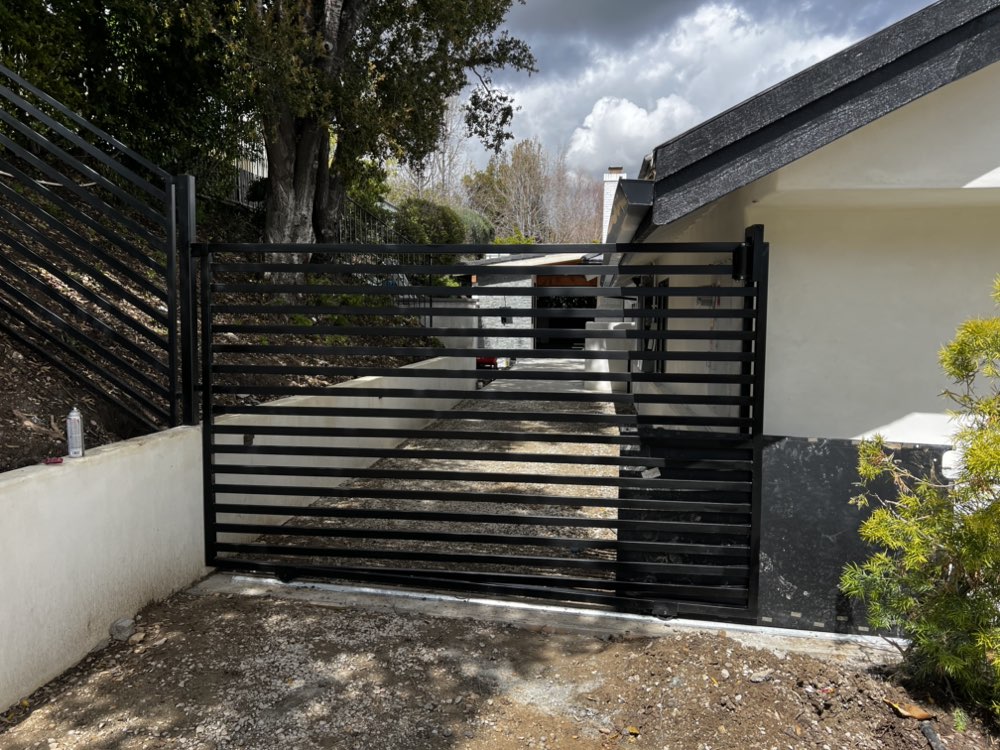
Most people arrive at this decision with a photo. They have seen a gate they like, and they want that gate. Fair enough — but the driveway usually has an opinion, and it tends to win.
The honest short version: your slope and your available space decide this more often than your taste does. Here is how to work out which side you fall on before you get attached to a design.
The Quick Answer
| Your situation | Usually points to |
|---|---|
| Driveway slopes up from the street | Sliding |
| Short driveway, car parks near the gate | Sliding |
| Level driveway with room to open inward | Swing |
| Estate entrance, want a traditional look | Swing |
| No side room along the fence line | Swing |
| Very wide opening | Either — bi-parting swing or cantilever slide |
Why Slope Matters So Much
This is the single biggest factor and the one people rarely think about until we point at the ground.
A swing gate sweeps an arc. If the ground rises as it swings, the bottom of the gate collides with the driveway before it is fully open. On a gentle rise you can hang the gate higher, but that leaves a bigger gap underneath — which matters if you have dogs or want the gate to read as solid.
A sliding gate travels sideways, parallel to the ground. It simply does not care what the driveway does. On the hillside properties around Ventura, Ojai and the Malibu canyons, this ends the conversation on its own.
Why Space Matters Almost as Much
A swing gate needs a clear arc inside the property. That sounds obvious until you count the things that live in that arc: a parked car, a planter, a retaining wall, a slope, the mail box.
Short driveways are the classic problem. If your driveway is only a car length deep, a swing gate opening inward will hit the car, and one opening outward will swing into the street — which most jurisdictions do not allow and which is genuinely dangerous.
A sliding gate has a different requirement: it needs room to travel sideways. A rolling gate needs roughly the width of the opening again running alongside the fence. If your property line stops right at the gate post, that space does not exist.
Rolling vs Cantilever Sliding Gates
If you land on sliding, there are two ways to do it.
Rolling gates run on wheels along a track set into the driveway. Simpler and generally less expensive. The track needs to stay clear — leaves, gravel and dirt in a track cause more service calls than any other gate problem we see.
Cantilever gates hang from rollers on posts to one side and span the opening with no track on the ground at all. More expensive and they need more side room, but nothing to sweep out, and no track to be damaged by vehicles. On a property with a gravel drive or heavy leaf fall, the extra cost usually pays for itself.
Single vs Double Swing
If you land on swing, a wide opening does not have to mean one enormous leaf. A bi-parting pair splits the weight, halves the arc each leaf needs, and looks right on a formal entrance. It does mean two operators.
The Part Everyone Forgets: The Operator
The gate is only half the purchase. The operator has to be sized to the actual weight, width and travel of the gate — and a custom gate does not have a catalog weight.
This is where buying a gate from one place and having someone else automate it goes wrong. An undersized operator on a heavy ornamental gate will work for a while and then fail early, usually in winter when everything is stiffer. We build the gate and set the motor, so the operator is matched to what we actually made.
Worth asking about at the same time: keypad or intercom at the driveway, smartphone control, safety photo eyes, and battery backup. Details on all of it on our driveway gates page.
What We Do Before Recommending Either
We come out and look. We measure the opening, check the slope, see where the power is, look at where a car actually stops, and ask how you want to let people in. That visit is free, and it usually settles the sliding-versus-swing question in a few minutes — often in a direction the homeowner had not expected.
If you are still weighing materials as well as mechanism, our guide to the best driveway gate materials covers how iron, steel, aluminum and wood compare on cost and coastal durability.
Common Questions
Is a sliding gate more expensive than a swing gate?
Often, but not always. A sliding gate is usually one large leaf with a track or cantilever system and a heavier-duty operator, which pushes cost up. A double swing gate needs two operators. The design and the width of the opening usually influence the final number more than the mechanism does, so it is worth pricing both rather than assuming.
Can I put a swing gate on a sloped driveway?
Sometimes, with the right design. Options include hanging the gate to swing downhill, using a swing-away or rising-hinge system, or regrading the apron. All add cost and complexity. On a meaningful slope, a sliding gate is usually the cleaner and cheaper answer, which is why we recommend it so often on hillside properties.
How much room does a sliding gate need?
A rolling gate needs roughly the width of the opening again, running alongside the fence line, for the gate to slide into. A cantilever gate needs somewhat more but keeps the driveway surface clear of track. If you do not have that side room, a swing gate or a bi-parting design may be the only option, which is exactly the kind of thing a site visit settles in five minutes.
What happens to my gate in a power outage?
Every operator we install has a manual release so you can open the gate by hand. If you are on a hillside or somewhere that loses power in winter storms, ask us about battery backup — it is the difference between a gate that still works during an outage and one you are pushing open in the rain.
Legendary Metal Works Inc. is a family-run metal fabrication shop in Ventura, California, building custom gates, railings, doors and fencing for Ventura County since before most of the crew could drive. CA Contractor License #1119503.