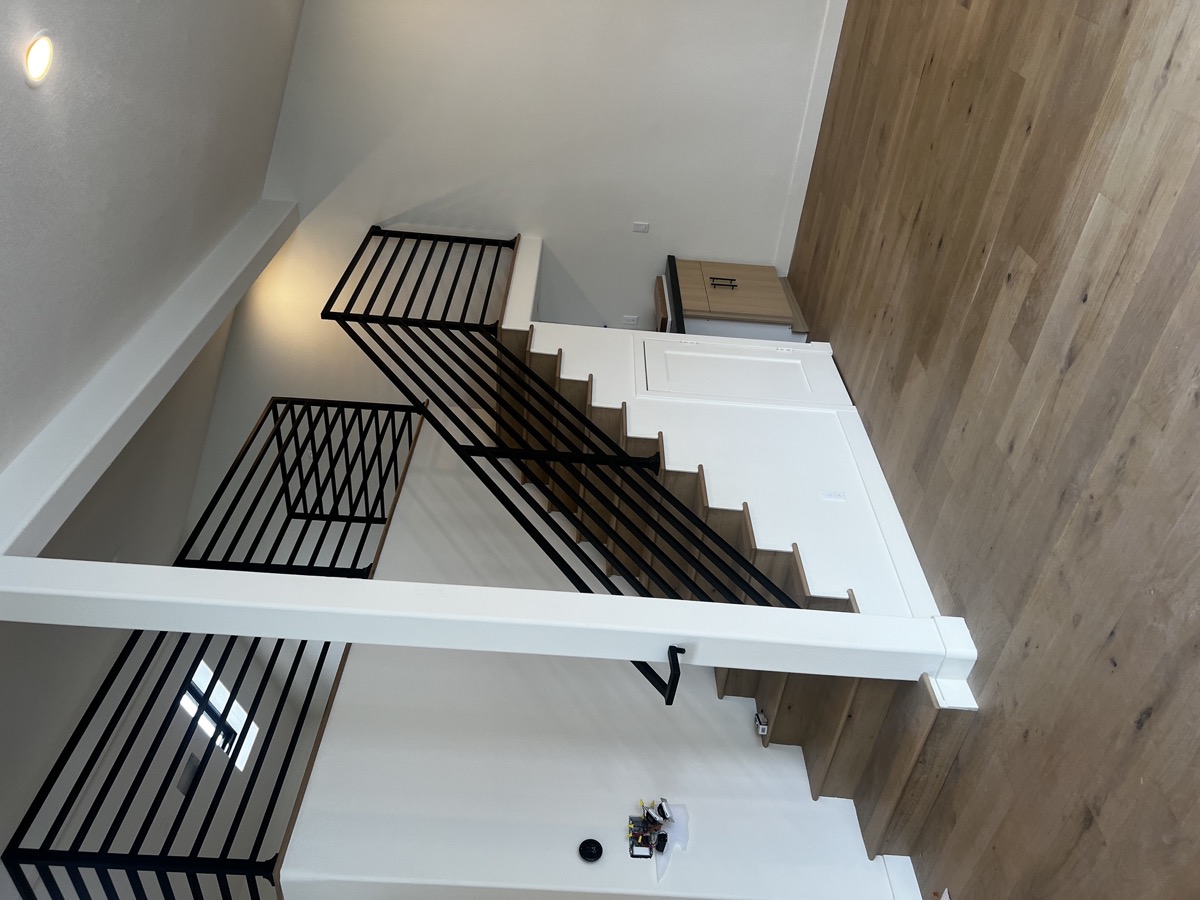
Railing quotes are quoted per linear foot, which makes them look easy to compare and often makes them impossible to compare. Two shops can quote the same staircase $9,000 apart and both be quoting honestly — they are just not quoting the same railing.
Here is what iron stair railings actually cost in Ventura County in 2026, and how to read a per-foot number so it means something.
The Short Answer
- Materials and fabrication: $80 – $250+ per linear foot
- Installation: $20 – $50 per linear foot
- Total installed: $100 – $300+ per linear foot
A typical straight interior staircase run of 15 to 20 feet therefore lands somewhere between $1,500 and $6,000 installed, depending almost entirely on design and mounting. A curved staircase, a multi-level open stairwell, or heavy ornamental work sits above that.
For comparison, stainless cable railing usually runs $85 to $210 per linear foot installed. Our iron vs cable comparison covers where each one wins.
What Moves the Number
1. Straight, curved, or multi-level
This is the biggest single factor and the one homeowners least expect. A straight run is repeatable work. A curved staircase means every picket is a different length and the top rail has to be rolled or segmented to follow the radius. The same twenty feet of railing can double in price purely because the stair curves.
Multi-level open stairwells — where the railing continues up past a landing and along a loft edge — add complexity at every transition point, and transitions are where the labor is.
2. Picket style and spacing
Plain vertical square bar is the baseline. Horizontal bars, geometric patterns, forged detail, twisted stock, laser-cut panels and scrollwork all add fabrication hours. This is the part of the budget you control most directly — a structurally identical railing can vary by thousands purely on how much detail is in it.
Spacing is not a style choice, though. Guardrails have to reject a 4-inch sphere under California residential code, which sets your maximum picket gap regardless of what looks good.
3. How it mounts
Core-drilling into concrete or stone, surface-mounting to wood framing, side-mounting to a stringer, or fascia-mounting to a pony wall are all different jobs with different hardware. Mounting into an existing finished surface — where the tile, stone or hardwood is already down and cannot be damaged — costs more than mounting during construction, because the work is slower and the tolerance for error is zero.
4. Interior or exterior
Exterior railings need a real finish system: proper prep, primer, and a powder coat or high-grade paint. Near the coast in Ventura, Oxnard or Malibu, they need galvanizing and stainless hardware on top of that, which adds roughly 10 to 20 percent and roughly doubles the service life.
Interior railings can skip the corrosion package but often gain cost elsewhere, because the finish is being viewed from two feet away in good light rather than from the street.
5. Code-required work you may not have budgeted for
Guardrails are structural. They have to resist real lateral force at the top rail, which is why a guardrail is not the same product as a decorative screen even when they look similar. If you are adding a guardrail to an open stairwell, a loft edge or a low pony wall that never had one, the mounting substrate sometimes needs blocking or reinforcement added before the railing goes on. That is legitimate work and it should be on the quote. Our guide to interior safety guardrails covers what is involved.
Two Examples
Straight interior stair, 16 feet, plain vertical pickets, surface-mounted to wood, satin black powder coat. This is the bread-and-butter job. Expect roughly $1,900 to $3,200 installed.
Curved interior stair, 22 feet, horizontal bar design, core-drilled into finished stone treads, with a matching landing guardrail. Same house, very different job. Expect roughly $6,000 to $11,000 installed.
Both of those are honest numbers for honest work. Neither is a better deal than the other — they are different railings.
How to Compare Railing Quotes
Ask each bidder the same four things:
- What stock are the posts and top rail? Wall thickness matters more than looks here. A guardrail has to hold a person.
- How is it mounted, and is any substrate reinforcement included?
- What is the finish system — prep, primer and topcoat, or just paint?
- Is it fabricated for this staircase, or assembled from stock parts?
That last question explains most large price gaps. Stock-part railings are cheaper and there is nothing wrong with them on a simple straight run. On anything with a curve, a transition or an unusual height, they end up looking approximate, because they are.
Where Cheap Railings Go Wrong
Railings fail in two ways. They come loose at the mount, which is a substrate or anchor problem and is genuinely a safety issue. Or the finish fails — rust bleeding at the welds within a couple of years, which is a prep problem. Both are decisions made at quote time, and neither is visible in a photograph.
What We Do
We fabricate every railing in our own Ventura shop rather than ordering stock parts, so the proportions, picket spacing and finish are chosen for your space. We will come out, measure, tell you what the code requires, and give you a real installed price — including telling you when a simpler design gets you what you actually want. Our railings page covers stair railings, balcony railings and interior guardrails, and our glass railings page covers the frameless option if you are trying to keep a view.
Common Questions
Why is a curved staircase railing so much more expensive?
Because nothing repeats. On a curved stair every picket is a different length and the top rail has to be rolled or segmented to follow the radius, so the fabrication is essentially bespoke from end to end. The same twenty feet of railing can cost roughly double what a straight run costs.
How far apart can railing pickets be?
California residential code requires that a guardrail reject a 4-inch sphere, which sets the maximum gap between pickets. That is a safety requirement rather than a style choice, and it applies regardless of the design you pick.
Is iron or cable railing cheaper?
They overlap. Iron typically runs $100 to $300+ per linear foot installed and cable typically runs $85 to $210. Cable is often chosen for the view rather than the price, and it needs more substantial end posts because the cables are under real tension.
Can you add a railing to a staircase that never had one?
Usually yes. The question is what it mounts to. Sometimes the existing framing takes the anchors directly; sometimes blocking or reinforcement has to be added first so the guardrail can resist real lateral force. We check that when we measure and tell you before we quote.
Do exterior railings cost more than interior ones?
Generally yes, because of the finish system. Exterior railings need proper prep, primer and a powder coat, and near the coast they need galvanizing and stainless hardware on top of that — roughly 10 to 20 percent more, for roughly double the service life.
Legendary Metal Works Inc. is a family-run metal fabrication shop in Ventura, California, building custom gates, railings, doors and fencing for Ventura County since before most of the crew could drive. CA Contractor License #1119503.