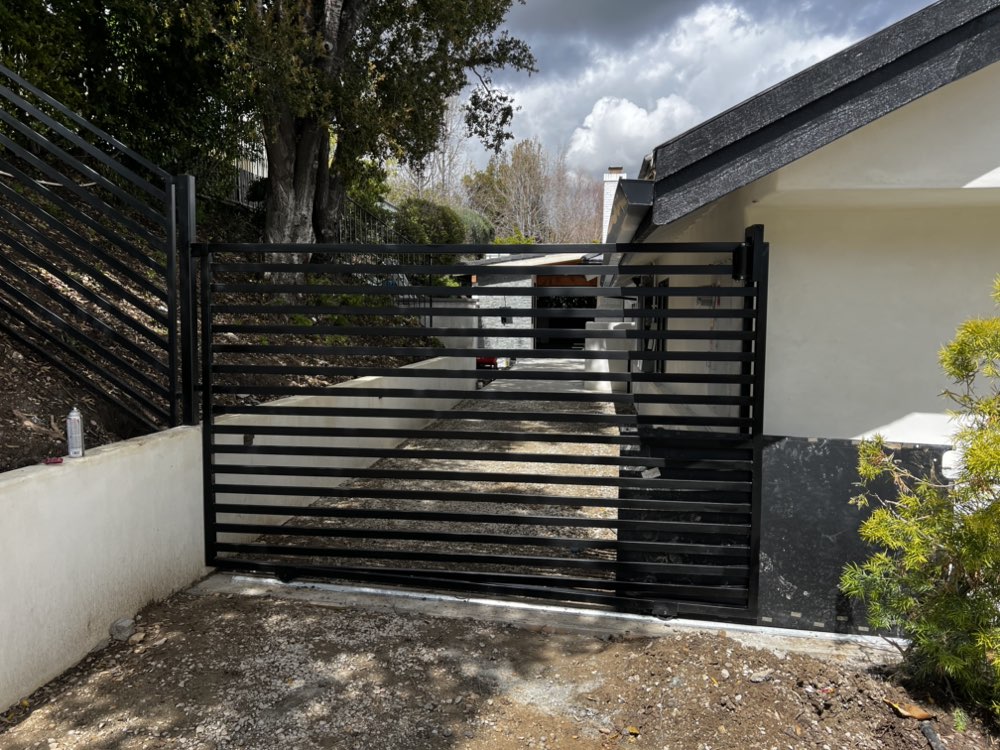
Your gate has stopped. You are sitting in the driveway, or worse, in the street. Before you call anyone, there are nine things worth checking — and in our experience a decent share of service calls turn out to be one of the first four.
None of this involves opening the operator housing or touching wiring. If a check below requires that, we have said so and told you to stop.
First: How to Get In or Out Right Now
Every automatic gate operator has a manual release. It is usually a lever or a keyed disconnect on the operator body itself. Releasing it disengages the motor from the gate so you can push the gate by hand.
Find yours on a calm afternoon, not during a power cut in the rain. If you have never located it, go and find it today — it is the single most useful thing you can know about your own gate.
The Nine Checks
1. Is there power at the gate?
Obvious, and still the most common cause. Check the breaker in the house panel that feeds the gate circuit. Check any disconnect or GFCI outlet near the operator — outdoor GFCIs trip in wet weather and stay tripped. If your gate has a solar panel and battery, look at whether the panel is shaded, dirty, or has been gradually covered by a growing shrub over the last two years.
2. Is something in the safety beam?
Photo eyes shoot an infrared beam across the gate path. If anything breaks that beam, the gate refuses to close — that is the safety system doing its job. Look for a trash bin, a parked car edge, an overgrown branch, a coiled hose, or a cat. Also check the lenses themselves: spider webs, dust, and wet leaves are just as opaque to the beam as a car is.
Wipe both lenses with a dry cloth and look again. This one fixes a surprising number of calls.
3. Are the photo eyes still aimed at each other?
Photo eyes are a matched pair and they have to point at one another. If a landscaper's mower, a delivery truck or a strong wind has knocked one a few degrees out of alignment, the beam misses and the gate behaves exactly as if something is in the way. Most units have an indicator LED that tells you whether they are seeing each other.
4. Is it just the remote?
Test the wall button, the keypad and the remote separately. If the keypad works and the remote does not, you have a remote problem, not a gate problem — usually a battery. If the remote works close up but not from the usual distance, that is also a battery. Keep a spare battery in the glovebox.
5. Is the track blocked, or the swing path obstructed?
On a rolling gate, the track collects leaves, gravel and grit. Enough of it and the gate binds, the operator senses excess force, and it stops. Sweep the whole run of the track, not just the visible part. On a swing gate, look for a settled paver, a raised root or a piece of debris in the arc.
Debris in a track causes more service calls than any other single thing we see.
6. Did anything change in the last week?
Trenching for irrigation, a new fence post, a tree removal, a driveway resurfacing, a power outage, a lightning storm. Gate faults that appear the day after work was done on the property are very often related to the work. Mention it when you call — it saves diagnostic time.
7. Is the gate itself sagging or dragging?
Release the manual disconnect and swing or roll the gate by hand. It should move with steady, even effort. If it drags on the ground, binds at one point, or wants to swing open on its own, you have a mechanical problem — a hinge, a roller, or a post — not an electrical one. The operator is stopping because the gate is fighting it, and that is the operator protecting itself.
This one matters, because forcing an operator to keep working against a binding gate is how a repair becomes a replacement.
8. Is there an error light or beep code?
Most modern operators show a fault code on a small display or blink an LED in a pattern. Note exactly what it does before you call, and if you can find the manual, look the code up. Telling a technician "three red flashes, pause, repeat" is worth ten minutes of on-site diagnosis.
9. Has it been hot, or very wet?
Control boards and capacitors are the components most sensitive to heat and moisture. A gate that fails during a heat wave and works again in the evening is telling you something specific. So is one that only misbehaves after rain. Both are worth mentioning — intermittent faults are the hardest ones to catch on a service call, so your observation is genuinely useful.
When to Stop and Call
Stop and call a professional if any of the following are true:
- You would need to open the operator housing or touch wiring to go further
- You smell burning, or see scorching around the control board
- The gate moves but makes a grinding or knocking noise
- The gate is heavy, hanging oddly, or you are worried it might fall
- The safety devices are not working — a gate that closes on an obstruction is dangerous and should be taken out of automatic operation until it is fixed
That last one is not a formality. Automatic gates are heavy powered machinery and the safety devices are the reason they are safe to have around children and pets. If the photo eyes are dead, leave the gate on manual until they are repaired.
What Repairs Usually Cost
Gate operators fail in fairly predictable ways — capacitors, control boards, limit switches, worn gears — and several of those are inexpensive parts. The expensive mistake runs in the other direction: replacing an entire operator when a capacitor failed. Diagnosis is the part worth paying for.
Mechanical faults are similar. A sagging gate is usually a hinge or a post, not the gate, and re-hanging a gate is straightforward work that can make a twenty-year-old gate close properly again. Our guide on when a gate is worth repairing covers where the line sits.
Two Habits That Prevent Most Failures
- Sweep the track and clear the swing path monthly. Two minutes. Prevents the most common call we get.
- Wipe the photo eye lenses when you wash the car. Also two minutes, also prevents a call.
We repair gates we did not build — that is most of our repair work. If you have run through this list and you are still stuck, call us and we will come and look. Our driveway gates page covers repair as well as new builds.
Common Questions
My gate will open but will not close. What does that usually mean?
Nine times out of ten it is the photo eyes. A gate is designed to refuse to close when the safety beam is broken, so an obstruction, a dirty lens, or a photo eye knocked out of alignment all produce exactly this symptom. Check for objects in the path, wipe both lenses, and see whether the alignment indicator lights are on.
Where is the manual release on a gate operator?
It varies by manufacturer, but it is always on the operator body itself — usually a lever, a keyed disconnect, or a cover you lift. Releasing it disengages the motor so you can move the gate by hand. Find yours before you need it rather than during a power cut.
The gate makes a grinding noise when it moves. Should I keep using it?
No. Grinding usually means a mechanical fault — a worn gear, a failing roller, or the gate binding against something. Continuing to run it turns a repair into a replacement. Put it on manual release and have it looked at.
Do you repair gates you did not install?
Yes, that is most of our repair work. We will also tell you honestly when a repair is not worth the money rather than selling you a fix that buys six months.
How quickly can someone come out?
Call us at (805) 396-9984 and we will tell you honestly what we can do and when. If your gate is stuck in a position that has you blocked in or out, say so when you call — that changes how we schedule it.
Legendary Metal Works Inc. is a family-run metal fabrication shop in Ventura, California, building custom gates, railings, doors and fencing for Ventura County since before most of the crew could drive. CA Contractor License #1119503.