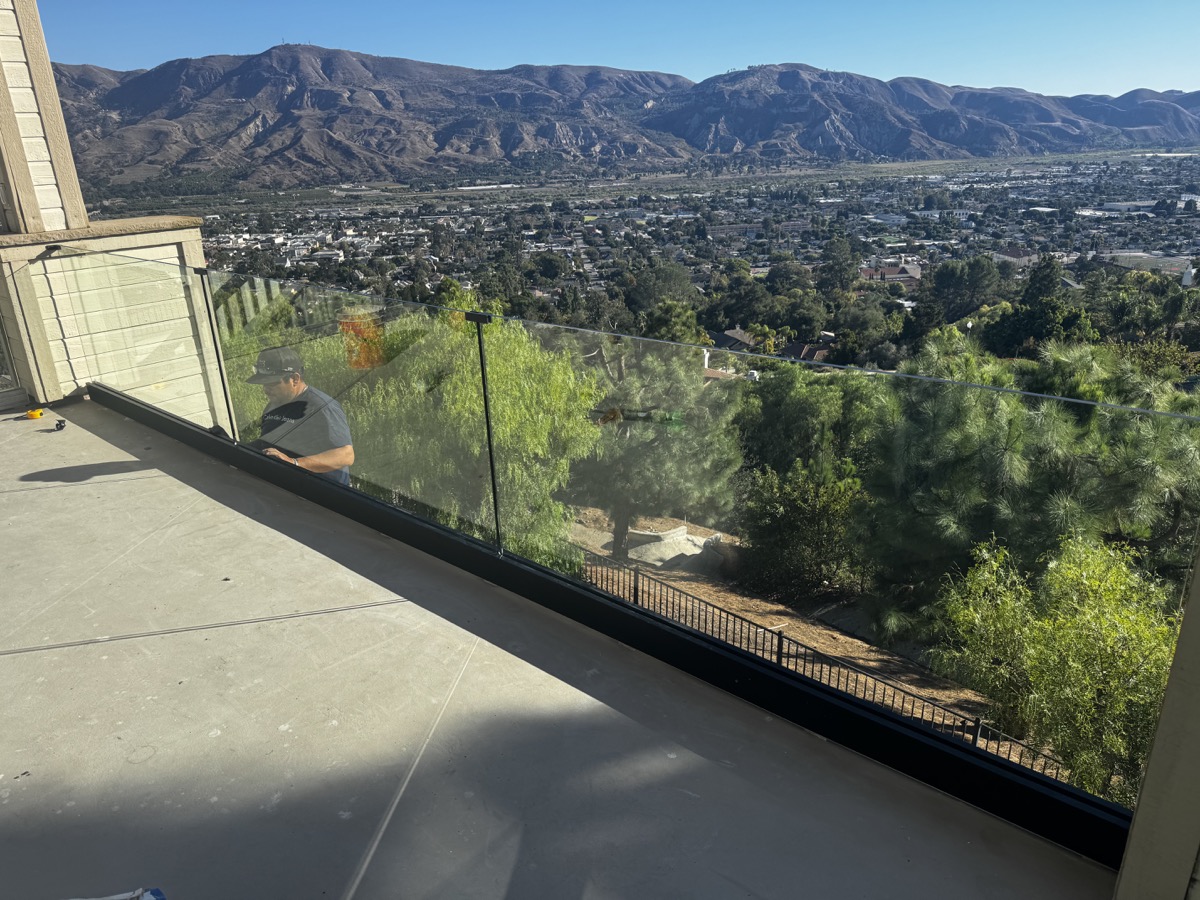
We get asked about price before anything else on glass, and most of the answers online are useless — either a national average that means nothing locally, or a range so wide it does not help you decide anything.
Here is a more useful way to think about it: we cannot quote you a per-foot number honestly, but we can tell you exactly what moves the price, so you can work out roughly where your project sits before anyone comes out.
What Actually Drives the Cost
1. Frameless or framed
This is the biggest single lever. A frameless system holds the glass in a continuous base channel or on standoff hardware, with no vertical posts. The glass itself is doing structural work, so it is thicker, and the channel that carries it is a serious piece of hardware. A framed system sets glass panels inside a metal frame with posts between them; the frame carries the load, so the glass can be thinner and the hardware lighter.
Frameless is the one you have seen on hillside terraces and it costs meaningfully more. Framed gets you most of the light and openness for less.
2. How many linear feet
Straightforward, but with a wrinkle: cost per foot usually drops a little as runs get longer, because setup, delivery and mobilization are spread across more work. A very short run can price surprisingly high per foot for exactly that reason.
3. Panel size
Large panels look better and cost more. Bigger glass means thicker glass, heavier handling, and sometimes more people or equipment on site to set it. There is a point where a panel needs mechanical lifting, and crossing that line changes the install cost noticeably.
4. Site access
The most underestimated factor. Glass on a ground-floor deck you can back a truck up to is one job. The same glass on a second-storey terrace up a narrow hillside driveway, carried by hand, is another. Ventura County has a lot of the second kind.
5. Hardware and finish
Standoffs, base channel, top rail or no top rail, and the finish on any visible metal. A slim stainless top cap on frameless glass is a small detail with a real cost attached.
The Trade-Off Nobody Mentions Until Afterward
Glass gets dirty, and it shows.
Metal railings hide dust. Glass does not. Add coastal salt spray — which reaches a long way inland around Ventura and Oxnard — and you get spotting that needs rinsing and squeegeeing to stay looking sharp. Not difficult, but real, and recurring.
We tell people this before they commit, because a customer who expected zero upkeep and got a weekly squeegee job is an unhappy customer even if the railing is perfect. Some hear it and decide the view is worth it. Others switch to cable, which keeps sightlines fairly open with none of the cleaning. Both are fine outcomes. Being surprised is not.
The Benefit People Do Not Expect
Wind.
A glass panel is a windbreak. On an exposed deck or hillside terrace — which is most of the places people want glass around here — that turns a space you avoid on a breezy afternoon into one you actually use. Customers who chose glass for the view routinely tell us the wind blocking is what they ended up appreciating most.
No picket or cable railing does this. If your outdoor space is windy, that alone may justify the price difference.
When Glass Is Worth It
- The view is the asset. If you are paying a premium for what you can see, a picket railing across it is working against you.
- The space is windy. The usability gain is real.
- Interior stairwells. Glass keeps daylight moving between floors in a way solid infill cannot.
- Pool enclosures. You can see children in the pool from anywhere in the yard.
When It Is Not
- There is no view worth preserving.
- The cleaning genuinely will not happen.
- The house is traditional and ornamental iron would suit it better. A Spanish-style home with wrought iron elsewhere is usually better served by matching that.
If you are weighing it up, our glass railings page covers frameless versus framed in more detail, and iron vs cable railing covers the two most common alternatives.
How to Get a Real Number
Have someone measure it. Any figure quoted without seeing the site is a guess, and on glass the site conditions — access especially — move the price enough that a guess is not worth much. Our consultation and written estimate are free, and we would rather tell you glass is the wrong call than sell you the expensive option.
Common Questions
Is glass railing more expensive than iron?
Generally yes, per linear foot. Glass guards use thick tempered or laminated safety glass and structural hardware, and both cost more than standard picket stock. Frameless costs more than framed because the glass and the base channel carry more of the structural load. The gap narrows on ornamental iron, where hand-formed scrollwork adds significant labor.
Does glass railing need a lot of maintenance?
It needs cleaning, not maintenance. There is nothing to rust, re-tension or repaint, but glass shows water spots and fingerprints in a way metal does not, and near the coast salt spray accelerates that. Realistically you will rinse and squeegee it periodically. If that sounds like a chore you will resent, cable railing may suit you better.
Is glass railing safe in an earthquake?
Glass guards are engineered systems built from tempered or laminated safety glass and designed to take the loads a guardrail must resist. Laminated glass in particular holds together rather than dropping out of its channel if it fractures. We build to the requirements that apply to your installation and coordinate with your building department when a permit or inspection is required.
Can glass railing be repaired if a panel breaks?
Individual panels can be replaced without rebuilding the whole run, which is one of the practical advantages of a panelized system. Cost depends on panel size and whether the hardware also needs attention. It is worth keeping a note of the panel dimensions and glass spec somewhere you can find it later.
Legendary Metal Works Inc. is a family-run metal fabrication shop in Ventura, California, building custom gates, railings, doors and fencing for Ventura County since before most of the crew could drive. CA Contractor License #1119503.